Skip to content
Call: +919866784338, +1(480)5807667
Email: info@jabharathsefoundation.org
Login/Register
Dashboard
LMS J&A Bharat / Global HSE Foundation
  • Category
    • Chemical
    • Construction
    • Environment
    • Health
    • Management
    • Quality
    • Safety
  • About Us
  • Events
  • Courses
  • Instructors
  • Contact
0

Currently Empty: $0.00


Continue shopping

Register
LMS J&A Bharat / Global HSE Foundation
  • About Us
  • Events
  • Courses
  • Instructors
  • Contact
  • Home
  • Course
  • Handling of Compressed Gas Cylinders

Handling of Compressed Gas Cylinders

  • By jabharathsefoundation
  • Chemical
  • (0 Rating)
Breadcrumb Abstract Shape
  • Course Info
  • Instructor
  • Reviews
  • More
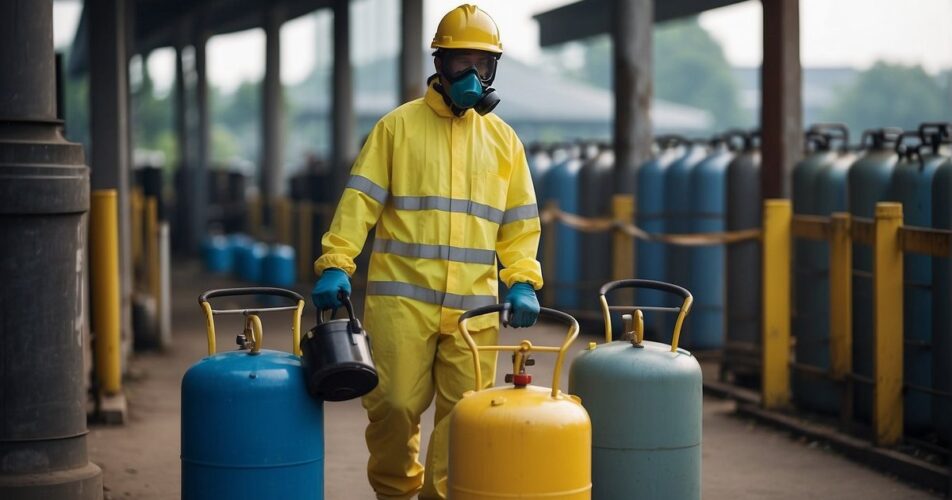
    • Compressed gas cylinders must always be handled with extreme care – secure them properly, keep protective caps on when not in use, and store them upright in well‑ventilated areas away from heat or ignition sources. Mishandling can lead to leaks, explosions, or severe injuries.

      General Handling

      • Always transport cylinders upright using a cylinder cart with straps or chains.

      • Never drag, roll, or drop cylinders—physical damage can compromise integrity.

      • Keep valve protection caps on when cylinders are not in use.

      • Use proper regulators and equipment designed for the specific gas type.

      • Open valves slowly to avoid sudden pressure surges.

      Storage Requirements

      • Secure cylinders with chains or straps at two‑thirds height to prevent tipping.

      • Store upright in a cool, dry, well‑ventilated area.

      • Separate flammable gases (e.g., hydrogen, acetylene) from oxidizers (e.g., oxygen) by at least 20 feet or with a fire‑resistant barrier.

      • Avoid direct sunlight and heat sources—temperature extremes can increase pressure inside.

      • Label cylinders clearly and group them by type (full, in‑use, empty).

      Usage Precautions

      • Check for leaks using approved methods (never with a flame).

      • Never tamper with safety devices like pressure relief valves.

      • Do not use oil or grease on oxygen cylinder valves or regulators—risk of fire/explosion.

      • Close valves tightly when not in use, even if empty.

      • Return empty cylinders with caps on and marked as “empty.”

      Show More
      What Will You Learn?
      • Safe Handling Techniques
      • How to properly move, lift, and secure cylinders to prevent accidents or damage.
      • Storage Requirements
      • Best practices for storing cylinders upright, segregating incompatible gases, and keeping them away from heat sources.
      • Usage Procedures
      • Correct ways to connect regulators, open valves, and check for leaks without creating hazards.
      • Emergency Response
      • Steps to take if a cylinder leaks, is damaged, or is exposed to fire, including evacuation and reporting protocols.
      • Risk Awareness
      • Understanding the dangers of explosion, toxic exposure, asphyxiation, and projectile hazards if cylinders are mishandled.
      • Regulatory Compliance
      • Familiarity with OSHA, ANSI, and other workplace safety standards that govern compressed gas use.

      Material Includes

      • Course Handbook / Manual
      • Detailed guide with safety procedures, diagrams, and regulatory standards.
      • Safety Data Sheets (SDS)
      • Reference sheets for common gases (oxygen, nitrogen, acetylene, etc.).
      • Instructional Videos
      • Demonstrations of proper handling, storage, and emergency response.
      • Case Studies
      • Real‑world examples of accidents and best practices.
      • Checklists & Posters
      • Quick‑reference materials for workplace use.

      Requirements

      • Basic Literacy & Comprehension
      • Ability to read safety manuals, labels, and instructions.
      • Physical Capability
      • Must be able to safely move and secure cylinders (with equipment assistance).
      • Personal Protective Equipment (PPE)
      • Learners must bring or be provided with gloves, goggles, and protective clothing.
      • Pre‑Course Orientation
      • Familiarity with workplace safety policies and emergency procedures.
      • Age & Authorization
      • Typically restricted to adults (18+) or authorized trainees in technical programs.
      • Attend All Sessions
      • Complete both theory and practical modules to qualify for certification.
      • Follow Safety Rules Strictly
      • No horseplay, shortcuts, or unauthorized handling of cylinders during training.
      • Participate in Hands‑On Exercises
      • Practice securing, transporting, and connecting cylinders under supervision.
      • Engage in Emergency Drills
      • Actively take part in leak detection, evacuation, and fire response simulations.
      • Complete Assessments
      • Pass quizzes and final evaluation to demonstrate competence.
      • Respect Equipment
      • Use training cylinders, regulators, and carts responsibly—report any damage immediately.
      • Ask Questions
      • Clarify doubts during demonstrations to ensure full understanding.

      Audience

      • Laboratory Technicians & Researchers
      • Working in chemical, biological, or medical labs where compressed gases are used daily.
      • Industrial Workers & Engineers
      • Employees in manufacturing, welding, fabrication, and other industries that rely on gases like oxygen, acetylene, or nitrogen.
      • Healthcare Professionals
      • Hospital staff, anesthetists, and medical technicians who handle oxygen and other medical gases.
      • Maintenance & Facility Staff
      • Personnel responsible for storage, transport, and upkeep of gas cylinders in workplaces.
      • Students & Trainees
      • Those studying chemistry, engineering, or vocational trades where compressed gases are part of the curriculum.
      • Safety Officers & Supervisors
      • Individuals tasked with enforcing workplace safety standards and training staff.
      • Emergency Responders
      • Firefighters, hazmat teams, and first responders who may encounter compressed gas cylinders during incidents.

      Course Content

      HANDLING OF COMPRESSED GAS CYLINDERS

      • Outline
      • Introduction
      • Segregation
      • Handling Precautions
      • Handling Precautions
      • Handling Precautions
      • Handling Precautions
      • STORAGE
      • Personal Protective Equipment
      • CONCLUSION
      • Thank You

      Tags

      • Chemical
      • Environment
      • Health
      • Safety

      A course by

      J
      jabharathsefoundation

      Student Ratings & Reviews

      No Review Yet
      No Review Yet

      Course Includes:

      • Price:Free
      • Instructor:jabharathsefoundation
      • Duration: 3 hours
      • Lessons:11
      • Students:0
      • Level:Intermediate
      Wishlist

      Share On:

      Courses You May Like

      construction safety1
      2 hours 30 minutes
      Beginner
      Construction Safety
      (0.0/ 0 Rating)
      Free
      • 15 Lessons
      • 0 Students
      Beginner
      Construction Safety
      (0.0/ 0 Rating)
      Free

      Construction safety refers to the practices, standards, and precautions taken...

      • 15 Lessons
      • 0 Students
      Enroll Now
      confined space entry
      4 hours
      Beginner
      Confined Space Entry
      (0.0/ 0 Rating)
      Free
      • 34 Lessons
      • 0 Students
      Beginner
      Confined Space Entry
      (0.0/ 0 Rating)
      Free

      Confined Space Entry refers to the process of safely entering...

      • 34 Lessons
      • 0 Students
      Enroll Now
      chemical_spill
      4 hours 30 minutes
      All Levels
      Chemical Spills
      (0.0/ 0 Rating)
      Free
      • 27 Lessons
      • 0 Students
      All Levels
      Chemical Spills
      (0.0/ 0 Rating)
      Free

      Chemical Spill refers to the accidental release of a chemical...

      • 27 Lessons
      • 0 Students
      Enroll Now
      household chemicals
      3 hours
      Beginner
      Household Chemical Safety
      (0.0/ 0 Rating)
      Free
      • 14 Lessons
      • 0 Students
      Beginner
      Household Chemical Safety
      (0.0/ 0 Rating)
      Free

      Household chemical safety refers to the safe handling, storage, use,...

      • 14 Lessons
      • 0 Students
      Enroll Now
      chemicals
      3 hours
      All Levels
      Chemicals in Refinery
      (0.0/ 0 Rating)
      Free
      • 9 Lessons
      • 0 Students
      All Levels
      Chemicals in Refinery
      (0.0/ 0 Rating)
      Free

      Oil refineries rely on a wide range of chemicals -...

      • 9 Lessons
      • 0 Students
      Enroll Now
      chemical
      2 hours 30 minutes
      All Levels
      Chemical Solvents
      (0.0/ 0 Rating)
      Free
      • 20 Lessons
      • 0 Students
      All Levels
      Chemical Solvents
      (0.0/ 0 Rating)
      Free

      Chemical solvents are substances - most often liquids - that...

      • 20 Lessons
      • 0 Students
      Enroll Now
      chemical-safety
      5 hours 30 minutes
      All Levels
      Chemicals Safely
      (0.0/ 0 Rating)
      $80.00 Original price was: $80.00.$50.00Current price is: $50.00.
      • 52 Lessons
      • 0 Students
      All Levels
      Chemicals Safely
      (0.0/ 0 Rating)
      $80.00 Original price was: $80.00.$50.00Current price is: $50.00.

      Any substance which has a potential for harm is a...

      • 52 Lessons
      • 0 Students
      Enroll Now
      maxresdefault
      3 hours 30 minutes
      Beginner
      Back Safety & Lifting
      (0.0/ 0 Rating)
      Free
      • 25 Lessons
      • 1 Students
      Beginner
      Back Safety & Lifting
      (0.0/ 0 Rating)
      Free

      Back safety and proper lifting techniques are essential for preventing...

      • 25 Lessons
      • 1 Students
      Enroll Now
      Incident
      3 hours 30 minutes
      Beginner
      Accident Investigation
      (0.0/ 0 Rating)
      Free
      • 22 Lessons
      • 1 Students
      Beginner
      Accident Investigation
      (0.0/ 0 Rating)
      Free

      Accident investigation is the systematic process of examining the causes,...

      • 22 Lessons
      • 1 Students
      Enroll Now
      loss prevention
      8 hours
      All Levels
      Basics of Loss Prevention
      (0.0/ 0 Rating)
      $125.00 Original price was: $125.00.$100.00Current price is: $100.00.
      • 78 Lessons
      • 0 Students
      All Levels
      Basics of Loss Prevention
      (0.0/ 0 Rating)
      $125.00 Original price was: $125.00.$100.00Current price is: $100.00.

      The Basics of Loss Prevention course introduces learners to the...

      • 78 Lessons
      • 0 Students
      Enroll Now
      cropped-jabharath-logo-final-Copy.png

      The mission of the LMS J&A Bharat HSE Foundation is to protect people, property, and the environment.

      Icon-linkedin2 Icon-youtube Icon-instagram

      Online Platform

      • About Us
      • Courses
      • Instructors
      • Events

      Links

      • Contact
      • Instructor Registration
      • Student Registration
      • Privacy Policy
      • Terms and Conditions

      Contacts

      Add: Saroor Nagar, Hyderabad 500035.
      Call: +919866784338, 1 (480) 580-7667
      Email: jabharathsefoundation@gmail.com

      Copyright © 2027 LMS J&A Bharat HSE Foundation | All rights reserved
      0 0 0 0 2 9
      LMS J&A Bharat / Global HSE Foundation
      Sign inSign up

      Sign in

      Don’t have an account? Sign up
      Lost your password?

      Sign up

      Already have an account? Sign in
      Hi, Welcome back!

      Prove your humanity


      Forgot Password?
      Don't have an account?  Register Now